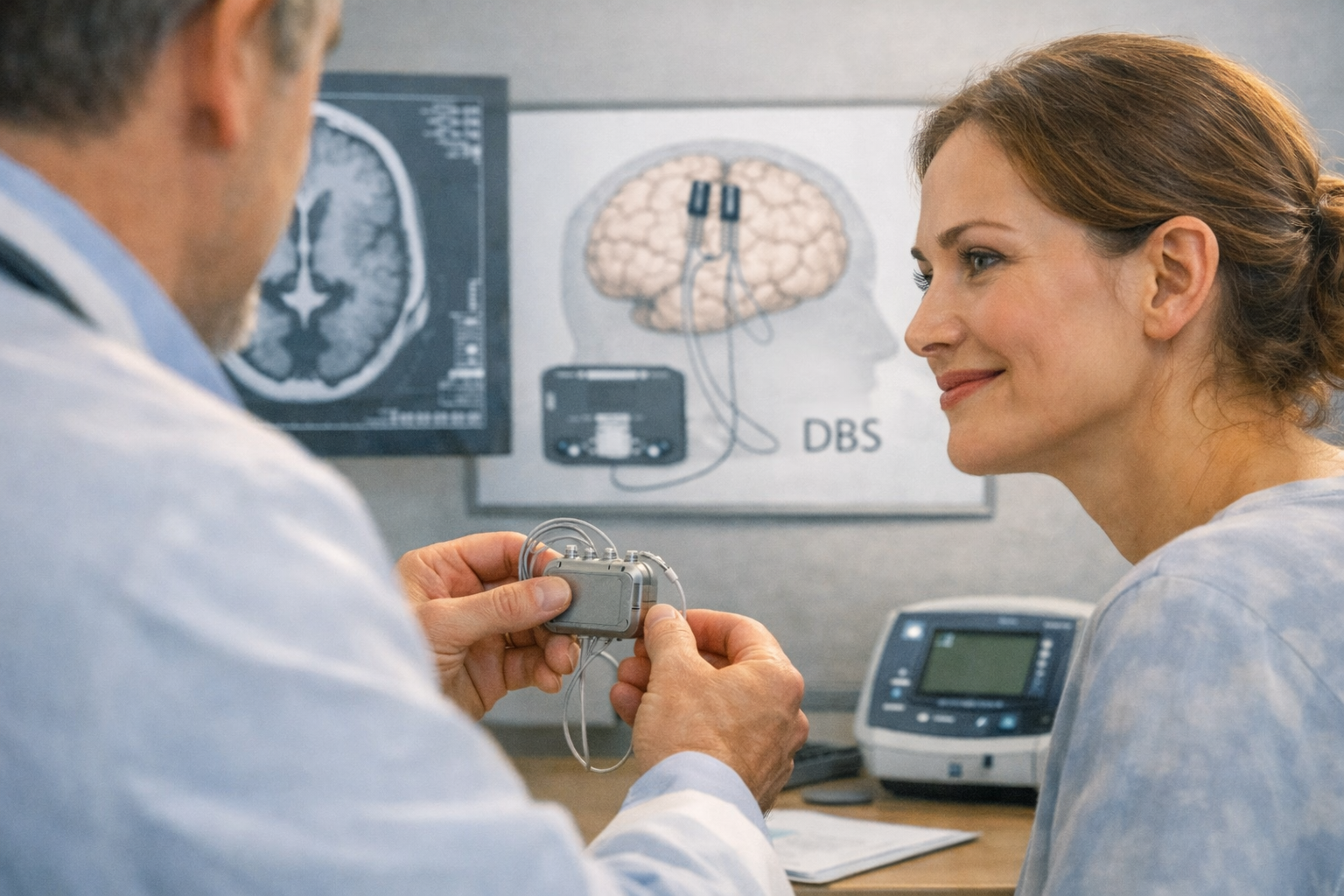
Who Is a Candidate for Deep Brain Stimulation (DBS) in Parkinson’s Disease? Is There a Right Time to Consider It?
The question “Who is suitable for DBS in Parkinson’s disease?” is one of the most common questions I hear in my clinic.
A patient’s relative recently asked me: “Doctor, we should have come earlier, right? We always thought medication was enough and surgery was the last resort. We waited until the last resort came.”
I hear this very often. Did we come too late? And my honest answer is this: thinking of Deep Brain Stimulation (DBS) as a “last resort” is not really accurate. What truly matters is discussing surgery for the right patient, at the right time.
In this article, I want to address two questions together: Who is a suitable candidate for DBS? And perhaps more importantly — why should we avoid waiting until complications are deeply established? Why does delaying the decision often fail to help?
(For a more detailed explanation of DBS in Parkinson’s disease, you can read my related article.)
The Fundamental Rule: Why Levodopa Response Matters So Much
The most important criterion when considering DBS is the patient’s response to levodopa. There is a simple rule: whatever levodopa improves, DBS will also improve — and whatever levodopa does not improve, DBS will not.
Both treatments act on the same neural circuit responsible for movement control. Levodopa provides “fuel” to this circuit, while DBS suppresses excessive and irregular electrical activity within it. For either treatment to work, the circuit must still retain some functional capacity. If the circuit is no longer working, adding more levodopa will not help — and DBS will not help either.
This is why we ask patients during the initial evaluation: Does the medication help you? Even if its duration has shortened, does it still have a meaningful effect? Or has it stopped helping altogether?
A scenario where medication works but its effect is gradually shortening is promising for DBS. A scenario where medication provides no benefit at all requires more caution.
So Who Is Suitable for DBS in Parkinson’s Disease?
Before answering this, one point must be clear: the diagnosis must be certain.
Several conditions can mimic Parkinson’s symptoms. Distinguishing them usually requires at least 4–5 years of follow‑up and a clinical course that truly aligns with Parkinson’s disease.
Beyond this, the patients who benefit most from DBS typically share the following characteristics:
- Good response to medication, but with progressively shorter benefit
- Prominent dyskinesia (involuntary movements)
- Tremor as a dominant symptom
- Preserved cognitive function
- Psychiatric stability and realistic expectations
Among these, the two most critical factors are preserved medication response and preserved cognition. Patients who do not benefit from medication do not benefit from DBS either. In patients with cognitive impairment, adapting to the device becomes difficult, and DBS may further worsen cognitive status.
I also want to address a common misunderstanding. Many patients and relatives believe that DBS is only useful for tremor, and therefore if tremor is not prominent, the patient will not benefit. They ask this frequently. Of course, DBS is highly effective in tremor‑dominant patients. But this does not mean that DBS will be ineffective if tremor is not the main symptom. There seems to be a misconception here.
On the other hand, in atypical parkinsonism (such as PSP or MSA — “Parkinson plus” syndromes), in patients with significant dementia, or in those with uncontrolled psychiatric illness, DBS does not provide the expected benefit — and we do not offer surgery to these patients.
Why Waiting Until the “Last Resort” Often Fails to Help
For many years, DBS was viewed as a “last resort” — something to consider only in advanced stages when medications no longer worked. But evidence accumulated over the last decade has changed this perspective.
The EARLYSTIM trial, published in 2013 and considered a landmark study, showed that DBS performed during the early phase of motor complications provides significant advantages in quality of life, motor function, and psychosocial well‑being compared to the best medical therapy alone.
Early evaluation does not mean rushing into surgery. The goal is to assess the patient before complications become deeply entrenched — without missing the right time. There are several concrete reasons for this:
- Preventing entrenched problems: When dyskinesia and motor fluctuations continue for years, the neural circuit “learns” abnormal patterns. Early intervention can prevent this.
- Limiting medication dose: After DBS, medication dose can usually be reduced. When done earlier, this reduction protects the patient from long‑term medication side effects.
- Preserving active life: When the patient is still working and socially active, maintaining this period without complications is far more valuable than a late “rescue” surgery.
I also want to add a biologically plausible hypothesis: DBS may slow disease progression by suppressing certain overactive neural populations. Reduced levodopa use may also contribute indirectly. This effect is not yet proven in humans (only animal studies support it), but it is a reasonable theory explaining why early DBS may provide longer‑lasting benefit compared to late DBS.
There is no universal definition of “early.” Timing must be individualized.
To Be Honest: DBS Does Not Fix Everything
One of my most important responsibilities to patients and families is setting realistic expectations. DBS is very strong in certain areas. Tremor, for example, often remains well‑controlled even many years after surgery. Bradykinesia (slowness of movement), if it previously improved with medication, can become more stable with DBS.
But DBS has limited effect on freezing of gait and postural instability. We use a simple practical rule: If walking improves during the ON phase of medication, DBS can improve that part as well. But if walking is poor even when medication is at its best, DBS should not be expected to provide major benefit.
The Decision Is Not Made in a Single Visit
The decision for DBS is not made by a single doctor in a single examination. In our center, neurology, neurosurgery, and psychiatry evaluate the patient together. We review the entire medical history, medication use, disease stage, lifestyle, and expectations.
The goal is simple: to find the right moment for the right patient — not too early, not too late.
Most importantly, the decision is made together — both our team and the patient. If a patient is not suitable for DBS, we thoroughly review medication adjustments and other device‑assisted treatment options. We continue with the most appropriate therapies for the patient.
In short, there is no single answer to the question “Who is suitable for DBS in Parkinson’s disease?” The correct answer requires a personalized, collaborative evaluation.
If you or a loved one is living with Parkinson’s disease and you feel that medication effects are shortening and daily life is becoming more difficult, it may be beneficial to be evaluated for DBS. There is no need to postpone this evaluation thinking “it’s too early.” An early consultation does not necessarily lead to surgery — but it ensures you do not miss the right time.
For a brief evaluation and to contact me, you can visit my related page.
For detailed information about the surgical process, you can visit my Your DBS Journey page.
You can always reach me for questions.
📞 +90 216 542 6666
💬 WhatsApp: +90 531 460 7738
📧 mustafa.sakar@memorial.com.tr
📍 Memorial Göztepe Hospital, Ataşehir / Istanbul