A few days ago, a patient’s family asked me about DBS battery life through an intermediary — along with two other very practical questions: Which battery brand do we use? And if adjustments are needed later, does the patient have to fly back to Istanbul every time?
These are exactly the right questions to ask before DBS surgery — so let me answer them properly, including the parts that are often left out.
The Three Manufacturers
Today, three companies produce the DBS systems used worldwide: Abbott, Boston Scientific, and Medtronic. All three are approved by international regulatory authorities, all three have been used in tens of thousands of patients, and all three deliver the same core therapy for Parkinson’s Disease — electrical stimulation to specific brain targets to control tremor, bradykinesia, or rigidity.
At our center, we work with all three systems, choosing based on what fits each patient’s anatomy and lifestyle — not a fixed preference. What I want to emphasize is this: none of the three is clinically “stronger” or “weaker” than the others. The stimulation itself, and the benefit patients experience, is essentially equivalent across brands. The real differences lie in the additional features layered on top — and this is where families often get confused.
Rechargeable vs. Non-Rechargeable: The Real DBS Battery Life Question
The more important question about DBS battery life isn’t about brands — it’s between the two battery types offered by all three manufacturers.
- Non-rechargeable batteries: simple to use, but typically last only 3 to 5 years before they need surgical replacement.
- Rechargeable batteries: the patient charges the device at home, wirelessly, every few weeks. The listed lifespan across brands without losing performance ranges from 15 to 20 years. In real-world use, the practical lifespan is roughly 20 to 25 years — for most patients, this means the rest of their lives without another battery-replacement surgery. So the practical answer is: if you have a rechargeable battery, you will most likely never need a replacement.
This is why, today, a rechargeable system is my default recommendation whenever it is medically appropriate. But “appropriate” is not only a medical question — it is also a practical one. A rechargeable battery works well only if the patient (or a family member) can reliably manage the charging routine. For an older patient uncomfortable with technology, living somewhere with limited technical support, or without someone at home who can help if needed, a non-rechargeable battery can genuinely be the safer and more appropriate choice — even though it means a shorter lifespan and an eventual second surgery. This is not outdated technology; it is still the right answer for some patients.
A Word on “Extra” Features
Each manufacturer has introduced its own additional technologies on top of the core stimulation therapy — some offer brain-sensing “adaptive” stimulation that adjusts automatically based on recorded signals, others offer image-guided software to visualize the stimulation field during programming. These are impressive engineering achievements, and the research behind them continues to grow. I follow this work with real interest.
But there is one feature that, in my daily practice, makes a clear and immediate difference for most patients: remote programming.
An Important Distinction: A Controller Is Not the Same as Remote Programming
Every DBS system — rechargeable or not, from any manufacturer — comes with a small patient controller. It’s important to be clear about what this device actually does, because it’s easy to assume it already solves the travel problem. It doesn’t.
The standard patient controller allows you to switch the device on or off — for example, before an MRI or a surgical procedure — and make small adjustments within a narrow range that your doctor has already approved. It is not a programming tool. It cannot change targets, reshape the stimulation field, or make the kind of meaningful adjustment a neurologist or neurosurgeon performs during a proper follow-up session.
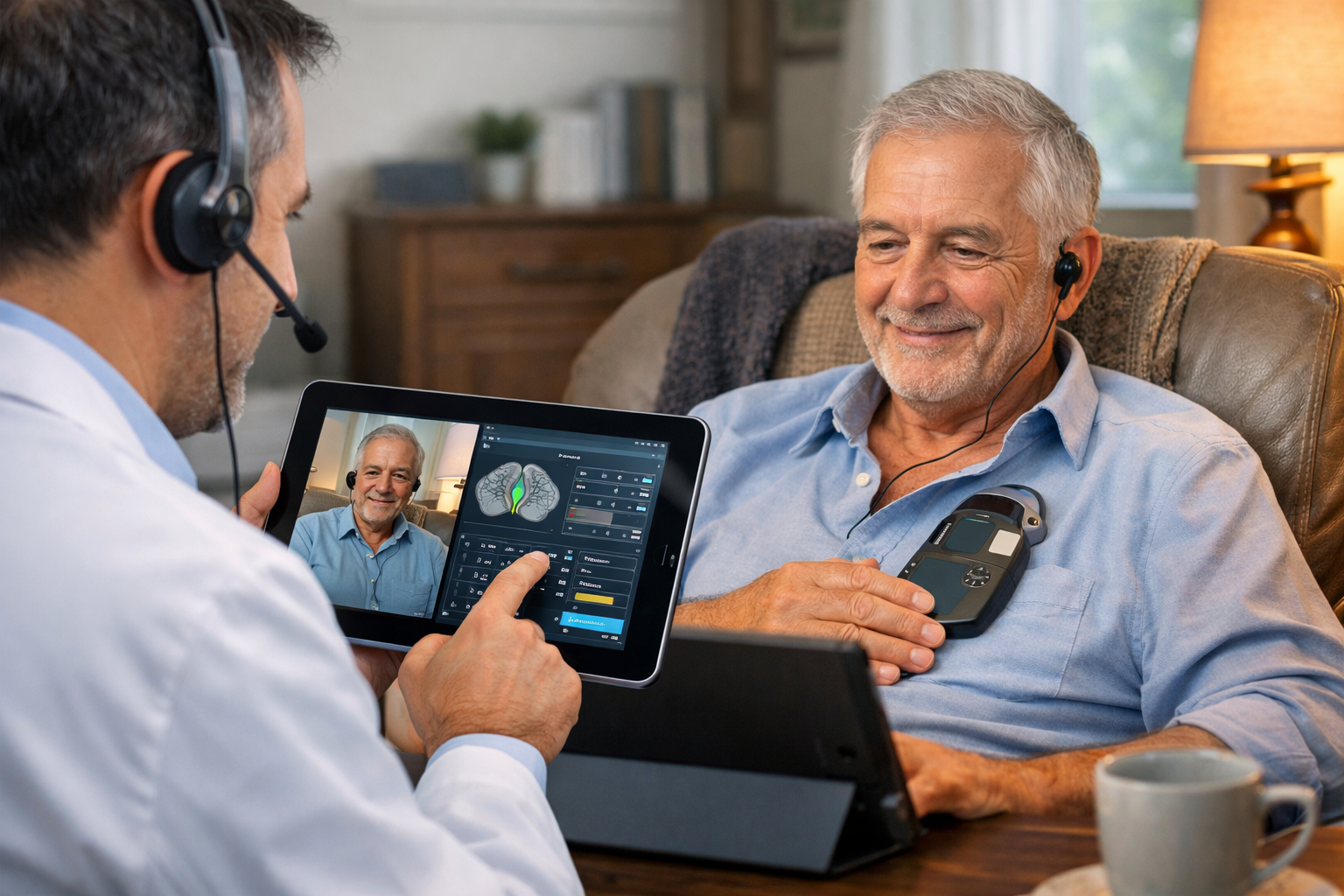
True remote programming is different: it gives the physician the same full programming capability remotely that they would have in the clinic, through a secure connection to the device.
I want to be direct about this distinction, because I don’t want any patient to assume “we already have a controller, so we’re covered.” Having a controller and having remote programming capability are two very different things.
Why This Matters More Than Most Patients Expect
Parkinson’s disease is progressive. Even an excellent initial programming session is not a one-time fix — as the disease evolves, the settings that worked well in the first month will usually need to be revisited. This is true for every patient, not only those who feel something has gone wrong. The accepted standard of care is a neurological review and, when needed, a programming adjustment roughly every six months.
For a patient living in Istanbul, that’s a short visit. For an international patient without remote capability, that means a recurring international flight — every six months, indefinitely.
I’ve seen what happens when this isn’t planned in advance. One patient, implanted at another hospital and now living in Tashkent, began worsening about eight months after surgery — more rigidity, less movement, a real decline in quality of life. Traveling back for a full reprogramming session wasn’t possible. All that was available locally was the basic patient controller, which simply cannot make that kind of adjustment. I saw this patient during an outpatient visit abroad. The family and I could not solve it, and all I could do was adjust his medication regimen. He was left managing worsening symptoms through medication alone, despite having already undergone the surgery meant to help.
Another patient, in Algeria, whom I saw during another outpatient visit abroad, was more than three years past surgery with no follow-up programming session at all. Symptoms had progressively worsened. It wasn’t even clear whether the device had ever been properly connected for an adjustment. The surgery itself had gone well — but without any mechanism for ongoing care, the patient was not receiving the benefit DBS can provide.
Both situations were preventable. Neither patient lacked access to a good surgery — what they lacked was a plan for what happens afterward.
Based on my experience over the years, the most common and important problems are related to follow‑up and the small programming adjustments that must be made over time.
What Remote Programming Actually Changes
With a rechargeable, remote-capable system, that six-month (or as-needed) adjustment can happen from the patient’s home, through a secure connection between the device and our clinic — with the same programming depth as an in-person visit. No flight, no hotel, no time away from work or family for a routine adjustment. I’ve used this system with patients from London, across the Balkans, and throughout Central Asia; all were able to complete full remote programming sessions after their initial ten days in Istanbul, with excellent and sustained results.
This also changes the length of the hospital stay itself, not just the later follow‑ups. Without remote capability, a patient would typically need to stay in Istanbul for 20 to 25 days after surgery, because the initial programming period isn’t a single session — it’s a process of activating the device, setting an initial program, and adjusting it repeatedly as the effect of the surgery settles and medication is reduced in parallel. With a remote-capable system, the patient stays for the first ten days — long enough for us to activate the device, complete the first programming session, and get to know the patient, their response pattern, and their contact details well. The remaining fine-tuning, which would otherwise mean another one to two weeks in Istanbul, is instead completed in one or two remote sessions after the patient has already gone home.
Remote programming does not mean a patient will never need an in‑person visit. It simply means that routine adjustments — the ones most patients need as their symptoms evolve — can be done remotely without travel. In-person evaluations are still important in rare or complex situations, such as unexpected symptom changes, hardware concerns, or the need for a physical examination. For most patients, these visits are infrequent, but it is still reassuring to know that remote programming reduces travel dramatically while keeping in-person care available whenever it is genuinely needed.
In my view, this is the single most practically meaningful piece of technology in modern DBS care for international patients — not because it is the most advanced feature on paper, but because it directly prevents the two situations described above.
So Which Brand Should You Choose?
When people ask about DBS battery life, the honest answer depends less on the brand and more on some other questions.
Honestly — this is a conversation to have with your surgeon after a full evaluation, not a decision to make based on brand name alone. What matters more than the logo on the device is:
- Is it rechargeable (and is that truly the right fit for this patient)?
- Does it support true remote programming?
- Does your surgical team have real experience using it consistently after surgery?
I want to be transparent: I have no commercial relationship or sponsorship with any manufacturer. I use all three, and I recommend based on what fits the individual patient.
If You’re Considering DBS
If you or a family member is evaluating DBS surgery, and questions like these — battery type, follow-up visits, what happens one or three years later — are part of what’s holding you back, I encourage you to fill out our short pre-assessment form. It takes a few minutes and gives us the information we need to provide an honest, personalized initial opinion.
For pre-assessment, you can visit my related page.
For detailed information about a 10-day period for DBS surgery in Istanbul, you can visit my “Your DBS Journey” page.
You can also read my article on this topic for in-depth information about candidacy for DBS surgery.
Feel free to reach out to me with your questions.
📞 +90 216 542 6666
💬 WhatsApp: +90 531 460 7738
📧 mustafa.sakar@memorial.com.tr
📍 Memorial Göztepe Hospital, Ataşehir / Istanbul