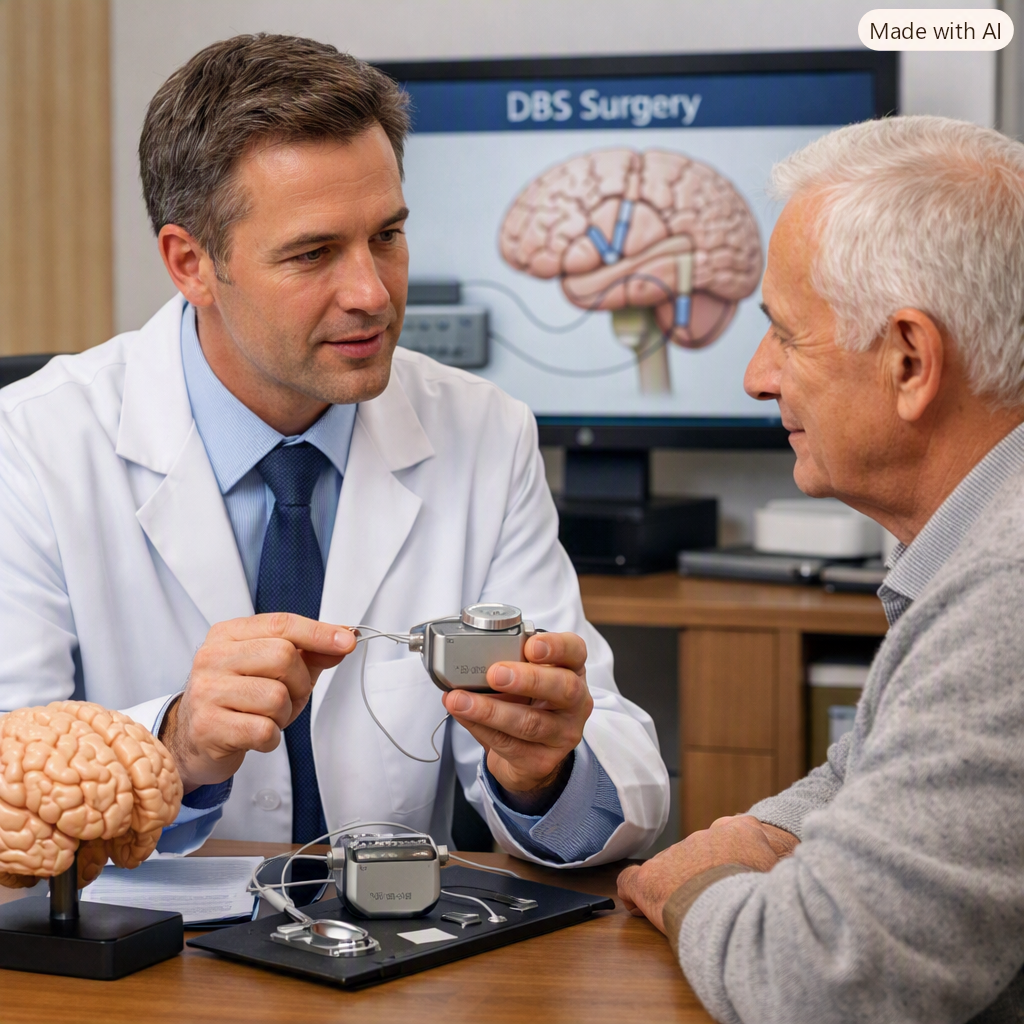
DBS Surgery Risks in Turkey: Explained by a Neurosurgeon
Deep brain stimulation (DBS) has one of the best safety records of any modern neurosurgical procedure, but it is still brain surgery — and no responsible surgeon will tell you it’s risk-free. If you’re researching DBS programs in Turkey, you’ve probably already read the marketing pages that promise life-changing results. This article takes the opposite approach: a plain, specific breakdown of what can go wrong, how often it actually happens according to published data, and — just as importantly — what separates a program that keeps those numbers low from one that doesn’t.
This isn’t meant to alarm you. Tens of thousands of patients worldwide have had DBS surgery safely and gone on to reclaim years of normal life from Parkinson’s disease, essential tremor, or dystonia. But an informed decision has to include the downside, not just the upside — especially when you’re trusting a team on the other side of the world with your brain.
Why This Question Matters More When You’re Traveling for DBS Surgery
When you’re evaluating a hospital in your own city, you can ask your neighbor, your family doctor, or the nurse down the hall how things usually go there. When you’re evaluating a center in another country, none of that local knowledge exists — you’re relying almost entirely on what the clinic’s own website and sales team tell you. That asymmetry is exactly why it’s worth knowing that complication reporting standards vary widely between clinics and countries — some publish detailed outcome data, others rely on testimonials alone. The only real protection is asking specific, answerable questions rather than accepting reassurance at face value.
Questions worth asking any center before you book, wherever it is:
- How many DBS cases has this specific surgeon performed personally, not just the hospital’s total volume?
- What is the surgeon’s own infection rate and hemorrhage rate over the last several years?
- Who manages programming and side-effect adjustments after you fly home — and how?
- What happens, concretely, if a complication occurs after you’ve already returned to your country?
The Surgical Risks (Common to Any Brain Surgery)
These risks apply to any procedure that involves placing electrodes deep in the brain, regardless of country, hospital, or brand of device. The figures below are broadly consistent with a published systematic review of DBS complication rates:
- Bleeding (intracranial hemorrhage): The most serious risk, occurring in roughly 1–3% of cases across published international series. The vast majority are small, incidental bleeds picked up on routine post-operative imaging that cause no lasting symptoms at all. Bleeds large enough to cause permanent neurological deficit or require a second operation are considerably rarer — well under 1% in most modern series — but they are the reason pre-operative imaging and trajectory planning matter so much.
- Infection: Reported in about 1–5% of DBS cases, and importantly, this is almost always a hardware infection (around the electrode, the extension wire tunneled under the skin, or the battery pocket in the chest) rather than a brain infection. Superficial infections usually respond to antibiotics; deeper hardware infections sometimes require temporarily removing part of the system and reimplanting once the infection has cleared — inconvenient and disappointing, but rarely dangerous if caught early.
- Lead misplacement or suboptimal placement: A rare but recognized issue where the electrode ends up close to, but not precisely within, the target structure — reducing the benefit a patient gets from stimulation. Modern intraoperative confirmation methods (microelectrode recording, awake testing, or intraoperative imaging) exist specifically to catch this before the patient leaves the operating room, rather than discovering it months later.
- Seizure: Uncommon and, when it happens, almost always a single, self-limited event related to the electrode’s path through brain tissue rather than a sign of lasting epilepsy.
- Stroke: Extremely rare, but the most serious possible complication of any intracranial procedure. This is the risk that careful vascular imaging and trajectory planning are specifically designed to minimize.
At a glance:
| Risk | Approximate rate |
| Bleeding (any) | 1–3% |
| Serious bleeding requiring further treatment | <1% |
| Infection | 1–5% |
| Lead misplacement needing correction | <1% |
| Seizure | <1% |
| Stroke | Very rare |
Figures are drawn from published international DBS series; a given center’s own rates depend heavily on volume and technique, as discussed below.
Risks More Specific to DBS Itself
Beyond the operation itself, DBS involves years of ongoing electrical stimulation through implanted hardware, which carries its own separate set of considerations — most of them manageable, none of them unique to Turkey as a destination:
- Stimulation-related side effects: Tingling, muscle pulling, speech changes, balance changes, or mood changes can occur, especially in the early weeks while settings are still being optimized. Almost all of these are dose-dependent and reversible by adjusting the stimulation parameters — this adjustability is precisely what makes DBS fundamentally different from older, permanent lesioning procedures like thalamotomy.
- Hardware complications: Lead fractures, wire erosion through the skin, or generator malfunction are possible over the years a device stays in place. Rates have fallen substantially with modern hardware generations, but they’re not zero, and they’re one more reason implant technique and post-operative wound care matter.
- Battery depletion and revision surgery: Not a surgical risk in the traditional sense, but a long-term reality — non-rechargeable batteries eventually need replacement, which means a shorter, lower-risk follow-up procedure every several years. Rechargeable systems change this picture substantially: manufacturers report functional lifespans well beyond 15 years, and even as charging capacity gradually declines with age, the device typically remains usable for years afterward rather than failing outright — for most patients, it’s close to a one-time implant rather than a recurring one. Remote monitoring also makes it far easier to know exactly when a battery genuinely needs attention instead of guessing. For a closer look at real-world battery life and remote programming, see this dedicated article.
- Cognitive or psychiatric changes: Rare, but reported in the literature, most often in patients with pre-existing cognitive vulnerability. This is one of the main reasons thorough neuropsychological screening before surgery isn’t a bureaucratic formality — it’s a genuine safety step.
What Actually Reduces DBS Surgery Risks
Risk isn’t a fixed number attached to the procedure — it moves substantially depending on the team, the technology, and the process around the surgery:
- Case volume and surgeon experience. This is the single most consistent finding across the DBS literature: surgeons and centers that perform DBS regularly have measurably lower hemorrhage, infection, and revision rates than low-volume centers. Ask directly how many cases the operating surgeon has personally done.
- Imaging and navigation accuracy. High-resolution pre-operative MRI, careful trajectory planning around blood vessels, and intraoperative neuronavigation all reduce the chance of a misplaced lead or an avoidable bleed. Ask what imaging protocol is used and whether the surgeon reviews trajectories personally.
- Careful patient selection. Not everyone with tremor or Parkinson’s disease is a good DBS candidate. A center that screens people out — because of cognitive status, unrealistic expectations, or a diagnosis that won’t actually respond to stimulation — is doing genuine risk reduction, even though it feels like a disappointing answer in the moment. If you’re unsure whether you meet the criteria, this in-depth look at DBS candidacy for Parkinson’s disease patients covers what actually matters.
- Sterile technique and hardware handling. Since most DBS infections are hardware infections rather than brain infections, meticulous handling of the extension wire and generator pocket during surgery matters as much as the intracranial part of the operation.
- Post-operative monitoring and remote programming access. Being able to adjust stimulation settings remotely, without requiring the patient to fly back to Istanbul for every fine-tuning session, means side effects get corrected in days rather than being tolerated for months until the next in-person visit is possible.
What Happens If a Complication Occurs After You’ve Gone Home?
This is the question international patients worry about most, and it deserves a concrete answer rather than reassurance. A responsible international DBS program should be able to tell you, before you ever book surgery: who you contact if something feels wrong at 2am in your own time zone, whether stimulation parameters can be adjusted remotely without traveling, and what the plan is if a hardware issue requires a local specialist to be involved. If a clinic can’t answer this clearly and specifically, that’s itself useful information.
A Realistic Way to Think About It
DBS carries real, documented risks — no responsible surgeon will tell you otherwise, and you should be skeptical of anyone who does. But for well-selected patients treated by an experienced team with modern imaging, careful technique, and genuine post-operative support, the serious-complication rate is low, and the procedure has close to three decades of outcome data behind it worldwide. The right question was never “is DBS risky” in the abstract — every brain surgery carries risk. The right question is: is this specific surgeon, at this specific center, with this specific track record and this specific plan for what happens after you fly home, the right fit for my case.
If you’d like an honest, case-specific assessment of whether DBS is appropriate for you, you can request a full risk profile based on your own MRI, symptoms, and medication response by completing the DBS Pre-Assessment form.
Related Reading
- The DBS Patient Journey: What to Expect, Step by Step
- DBS Battery Life and Remote Programming: What Patients Actually Want to Know
- DBS in Parkinson’s Disease: Who Is a Candidate?
- What Is Deep Brain Stimulation (DBS) in Parkinson’s Treatment? Is Surgery Really Necessary?
Have a Question?
If you’d prefer to discuss your specific case directly rather than through the form, I’m glad to answer questions personally.
💬 WhatsApp: +90 531 460 7738
📧 drmustafasakar@gmail.com
📧 mustafa.sakar@memorial.com.tr
📍 Memorial Göztepe Hospital, Ataşehir / Istanbul